
Rice Purity Test Score: What It Really Means and Why Everyone Is Taking It
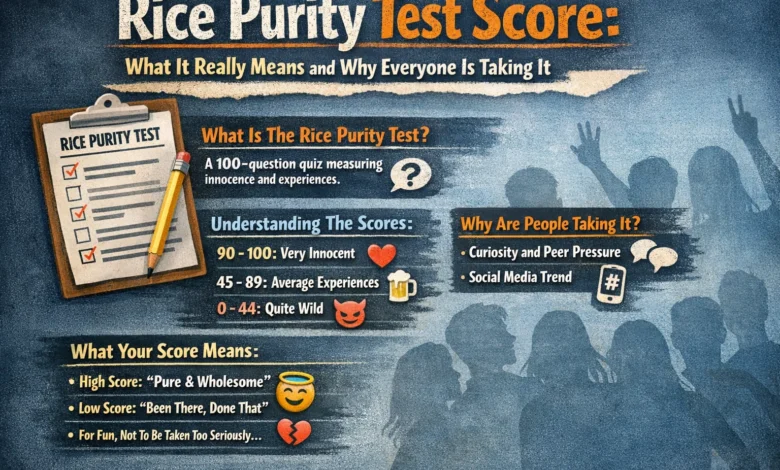
Rice Purity Test Score: If you have spent any time on TikTok, Twitter, or Reddit in the last few years, you have probably seen someone flashing a three-digit number with the hashtag #ricepuritytest. Maybe it was a 97, a 42, or a shocking 12. At first glance, the name sounds like something you would find in a home economics class or a food science lab. But the rice purity test has absolutely nothing to do with grain quality, cooking methods, or agriculture. Instead, it is a 100-question survey that has become a cultural phenomenon, particularly among college students and young adults.


The test originally started as a tradition at Rice University in Houston, Texas, hence the name. What began as a way for incoming freshmen to bond during orientation week has exploded into a global internet trend. Millions of people have taken the survey, posted their rice purity test score online, and compared their “purity” levels with friends and strangers alike. But what does that number actually mean? Is a high score good? Is a low score bad? And why does anyone care? This article breaks down everything you need to know about the rice purity test score, from its history to its scoring system, and why you probably should not take the results too seriously.
The Real Origin of the Rice Purity Test
Before the test went viral on TikTok, it lived a quiet life on college campuses. The rice purity test was created by students at Rice University in Houston, Texas, as a voluntary activity for orientation week. The goal was simple: help new students get to know each other, break the ice, and build a sense of community. It was never intended to be a scientific measure of a person’s character or morality. It was just a fun, slightly awkward way to see how your life experiences stacked up against your peers.
Over time, the test spread from Rice University to other colleges across the United States. Students would pass around photocopies of the 100 questions, fill them out with pen and paper, and then compare their rice purity test score with dorm mates. It was a bonding ritual, a conversation starter, and often a source of laughter or embarrassment. The transition to the digital world happened gradually, but when social media platforms like TikTok and Twitter embraced the trend, the test exploded in popularity. Suddenly, it was not just college students taking the survey. High schoolers, young professionals, and even some brave parents were getting in on the action.
How the Scoring System Actually Works
Understanding your rice purity test score is remarkably simple. The test consists of 100 questions, each asking whether you have engaged in a specific activity. These questions cover a wide range of topics, including romantic relationships, substance use, academic dishonesty, illegal activities, and personal habits. For every question you answer “No” to, you keep that point. For every “Yes,” you lose that point. You start with a perfect score of 100, and every “Yes” deducts one point from your total.
So, if you answer “No” to all 100 questions, your rice purity test score is 100. If you answer “Yes” to 30 questions, your score is 70. If you answer “Yes” to 85 questions, your score is 15. The lower your score, the more experiences you have had. The higher your score, the “purer” or more innocent you are considered by the test’s standards. It is worth noting that the test does not weight questions differently. Lying to your parents counts the same as breaking the law, at least in terms of scoring. This is one of the main reasons why the test is considered a fun activity rather than a serious assessment.
What Different Score Ranges Mean
While there is no official manual for interpreting a rice purity test score, the internet has developed a rough consensus on what different ranges signify. Keep in mind that these interpretations are subjective and meant for entertainment purposes only. A score between 100 and 98 is considered the “purest” tier. People in this range are extremely rare. They have likely never been in a romantic relationship, never touched alcohol or drugs, and never broken any rules. This is the “sheltered” score, though many would argue it just means you are very young or very focused on other things.
A rice purity test score between 97 and 94 suggests you are still very pure but have probably done a few minor things. You might have held hands with someone, kissed someone, or maybe told a lie to your parents. Scores between 93 and 77 are the most common. This is the “average” range. You have had some experiences, but nothing too wild. You might have drunk alcohol at a party, tried a cigarette, or engaged in some moderate romantic activities. Scores between 76 and 45 indicate a more experienced person. You have likely had several sexual experiences, experimented with drugs, or engaged in risky behavior. Scores between 44 and 9 are for the “hardcore” crowd. These individuals have had a wide range of intense experiences. Finally, a rice purity test score below 9 is extremely rare and suggests a very wild past.
The Viral TikTok Trend
The recent explosion in popularity of the rice purity test score can be attributed almost entirely to TikTok. The hashtag #ricepuritytest has accumulated hundreds of millions of views. The trend typically involves a user filming themselves taking the test, revealing their score with a shocked or proud expression, and then challenging their followers to do the same. Sometimes, users film their parents or grandparents taking the test, leading to hilarious and often awkward reactions when older generations answer the surprisingly candid questions.
Why did this specific trend catch fire? Part of it is the human desire for comparison. Everyone wants to know if they are “normal.” By posting a rice purity test score online, individuals invite comparison and validation. Another factor is the element of surprise. You might look at a sweet, innocent-looking person and assume they have a score of 95, only for them to reveal a 30. The contrast between expectation and reality is perfect for short-form video content. The test also offers a sense of community. When you see someone with a score similar to yours, you feel a kinship. When you see a score wildly different, it sparks curiosity.
Why the Test Is Not Scientifically Valid
It is crucial to emphasize that the rice purity test score has no scientific validity. It was created by college students, not psychologists or sociologists. The questions are not standardized, the scoring system is arbitrary, and the interpretations are subjective. Taking this test will not diagnose you with anything, predict your future behavior, or provide any meaningful insight into your mental health. It is purely a form of entertainment. Think of it as a personality quiz from a magazine, not a clinical assessment.
However, that does not mean the test is worthless. From a social perspective, it is fascinating. The rice purity test score acts as a cultural artifact. It reflects the behaviors and experiences that a particular group of people (in this case, American college students) consider significant or taboo. The fact that the test includes questions about drug use, sexual activity, and academic cheating tells us a lot about the anxieties and interests of young adults. Even though the test is not “real” in a scientific sense, its popularity is real, and the conversations it starts are real.
How to Take the Rice Purity Test
If you want to find out your own rice purity test score, the process is straightforward. Many websites host the test, but you should be careful about which one you use. Some sites are filled with intrusive ads or may try to collect your data. Look for a clean, simple interface. The official version of the test is often hosted on sites dedicated to the Rice Purity Test. When you find a reliable site, you will be presented with 100 checkboxes. You simply check the box next to each activity you have done. Do not overthink it. Answer quickly and honestly for the most authentic result.
After you have answered all 100 questions, you click a “Submit” or “Calculate” button. The site will instantly generate your rice purity test score. Remember, the score ranges from 0 to 100. Take a screenshot if you want to share it on social media. But before you post, consider whether you are comfortable with the world knowing those details about your life. While the test is anonymous, sharing your score can sometimes lead to awkward questions or assumptions. Many people choose to share just the number without explaining which questions they answered “Yes” to.
The Dark Side of Purity Culture
While the rice purity test score is generally harmless fun, it does touch on some sensitive issues. The very concept of “purity” can be problematic. Historically, purity culture has been used to shame people, particularly women, for their sexual behaviors. The idea that someone is “less pure” because they have had sex or experimented with drugs can reinforce negative stereotypes and lead to judgment. It is important to remember that having experiences does not make you a bad person, and lacking experiences does not make you a good person. The rice purity test score is not a measure of your worth.
Additionally, for some individuals, taking the test can be triggering. The questions ask about experiences like sexual assault, self-harm, and illegal activities. If you have trauma in your past, answering these questions might bring up difficult emotions. Be gentle with yourself. You do not have to take the test if it makes you uncomfortable. And if you do take it, remember that a low score does not mean you are broken or damaged. It just means you have lived a life. Everyone has a different path, and every path is valid.
Comparing Your Score to Others
One of the biggest temptations after getting your rice purity test score is to compare it to everyone else’s. This is natural, but it can also be unhealthy. If your score is much higher than your friends’, you might feel like you are missing out. If your score is much lower, you might feel ashamed or judged. Try to resist these feelings. The test is meant to be a conversation starter, not a competition. There is no “winning” the rice purity test. A score of 100 is not better than a score of 50. It is just different.
In fact, the most interesting conversations happen when scores vary widely. If you have a score of 90 and your best friend has a score of 20, you probably have very different life experiences. That is not a bad thing. It is an opportunity to learn about each other, to share stories, and to understand perspectives different from your own. The rice purity test score can be a bridge to deeper friendship, but only if you approach it with curiosity rather than judgment. Ask questions. Listen without lecturing. And remember that a number on a screen can never capture the complexity of a human life.
Table: Rice Purity Test Score Interpretation Guide
| Score Range | Typical Interpretation | Common Characteristics |
| 100 – 98 | Extremely Pure / Rare | Very sheltered, minimal life experiences, rarely found |
| 97 – 94 | Very Pure | Minor rule-breaking, limited romantic or substance use |
| 93 – 77 | Average / Moderate | Most common range, some experiences, balanced lifestyle |
| 76 – 45 | Experienced | Multiple relationships, likely drug/alcohol use |
| 44 – 9 | Very Experienced / Hardcore | Wide range of intense experiences, risk-taking behavior |
| 8 – 0 | Extremely Experienced | Very rare, very wild past |
Quotes: What People Say About Their Scores
“I got a 98 on the rice purity test, and my friends roasted me for being a nun. But honestly? I’m just not in a rush.” – Anonymous Reddit user.
“My mom took the rice purity test and got a 23. I will never recover from that knowledge.” – TikTok comment with thousands of likes
“The rice purity test score doesn’t define you. I got a 31, and I’m a perfectly functional adult. Mostly.” – Twitter user
These quotes highlight the mix of humor, shame, and pride that surrounds the test. It is a Rorschach test for the internet generation. How you react to your rice purity test score says more about you than the score itself.
Frequently Asked Questions (FAQ)
What is the average rice purity test score for most people?
The most common rice purity test score falls between 77 and 93. This range is considered “average” or “moderate.” Most people have had some experiences, but not an extreme number. However, averages can vary depending on age, cultural background, and the specific group of people taking the test. College students tend to have lower scores than high school students, for example.
Is a high rice purity test score good or bad?
Neither. A high rice purity test score simply means you have answered “No” to most of the 100 questions. It does not mean you are morally superior or a better person than someone with a low score. The test is not a judgment of character; it is a measure of specific life experiences. A high score might indicate youth, a sheltered upbringing, or personal choices. A low score might indicate adventure, risk-taking, or simply being older.
Can I retake the rice purity test to get a different score?
Yes, you can retake the rice purity test as many times as you want. It is free and widely available online. However, your score will only change if your answers change. If you retake the test a week later and answer the same way, you will get the same score. Some people retake the test years later to see how their experiences have accumulated. It can be a fun way to track personal growth over time.
Is the rice purity test safe to take online?
Generally, yes, but you should be cautious. The rice purity test does not ask for personal identifying information like your name, address, or credit card number. However, some websites that host the test may use intrusive advertising or track your browsing data. Stick to reputable sites that are dedicated specifically to the test. Avoid sites that ask you to create an account or provide an email address before seeing your results.
What should I do if my rice purity test score upsets me?
First, remember that the rice purity test score is not scientifically valid. It is a game, not a diagnosis. If your score upsets you, ask yourself why. Are you judging yourself for having too many experiences? Are you feeling insecure about having too few? These feelings might be worth exploring with a trusted friend or a therapist. Do not let a number on a screen dictate how you feel about yourself. You are infinitely more complex than 100 yes-or-no questions.
Conclusion
The rice purity test score is a fascinating internet phenomenon. It started as a simple icebreaker at a Texas university and grew into a global trend that has captivated millions. The test offers a rare combination of self-reflection, social comparison, and pure entertainment. It is fun to see how your experiences stack up against your peers. It is even more fun to watch your friends react to their own scores. But at the end of the day, it is just a game.
Do not let your rice purity test score define you. Do not use it to judge others or to feel ashamed of your own past. Whether you score a 99 or a 9, you are still the same person you were before you clicked “Submit.” The test does not measure your kindness, your intelligence, your loyalty, or your potential. It only measures 100 specific actions. Life is much bigger than that. So take the test, laugh at your score, share it if you want, and then close the tab. Go outside. Call a friend. Live your life. That is the only score that really matters.