
The Day the Skies Shook: A Deep Dive into the United Airlines Flight UA770 Emergency Diversion
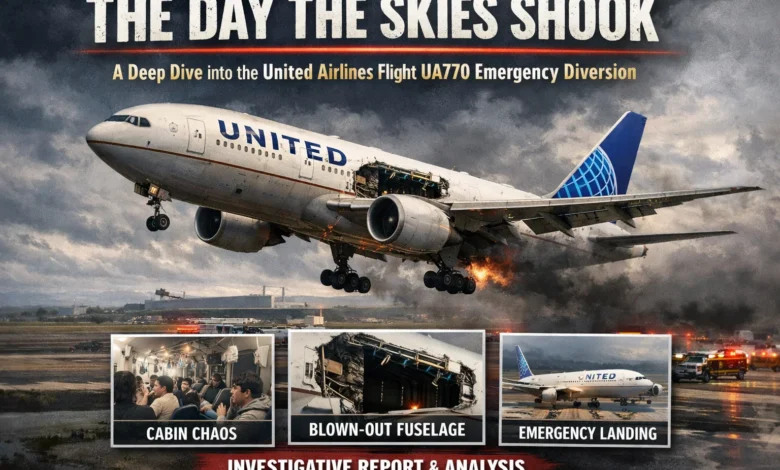
United Airlines Flight UA770 Emergency Diversion: There’s a specific kind of silence that falls over a crowded airplane when something feels wrong. It’s not the quiet of sleeping passengers, but the tense, alert hush of people holding their breath. That silence descended upon United Airlines Flight UA770, a routine transcontinental service, on a day that passengers and crew would never forget. What began as a standard journey from Los Angeles to Newark quickly transformed into a high-stakes ordeal, culminating in an emergency diversion that would make headlines and spark a nationwide conversation about aviation safety protocols.
The flight, operated by a Boeing 777, was threading its way through the busy airspace on approach to Newark Liberty International Airport. For the passengers, many of whom were checking phones or preparing for landing, the routine was shattered in an instant. Without warning, the aircraft was seized by a violent force of turbulence so severe that it defied the crew’s expectations and the forecasts they had reviewed. In a matter of seconds, the cabin—a place of cramped legroom and stale air—became a scene of chaos. Unsecured items became projectiles, and those who were not buckled in were thrown from their seats with terrifying force. This was not the mild jostling that flyers are accustomed to; it was a brutal, physical assault from the atmosphere itself.
This incident, officially investigated by the National Transportation Safety Board (NTSB), would later reveal a cascade of missed warnings and human errors that turned a turbulent patch of sky into a disaster zone for the flight crew. The story of UA770 is more than just a tale of a scary flight; it is a critical case study in how communication breakdowns can have direct, physical consequences thousands of feet in the air. It highlights the invisible network of information that keeps our flights safe and what happens when that network frays.
The Anatomy of an Emergency: What Happened on UA770?
To understand the magnitude of the United Airlines flight UA770 emergency diversion, one must first appreciate the chain of events that led to the mayday call. As the Boeing 777 began its initial descent into Newark, the cockpit crew was doing everything by the book. They had studied the weather forecasts, which indicated the presence of thunderstorms and general unsettled conditions in the region. They were monitoring their onboard radar systems, which showed a relatively clear path ahead. On the surface, it looked like a standard approach. However, the sky had other plans.
About three minutes before the aircraft hit the rough patch, another plane in the immediate vicinity encountered moderate turbulence. Following standard safety procedures, the pilot radioed in a Pilot Weather Report (PIREP) to air traffic control. This PIREP was a crucial piece of real-time data—a warning that there was rough air ahead that radar couldn’t always see. According to Federal Aviation Administration (FAA) procedures, this information should have been immediately relayed to other aircraft in the area, specifically United 770, which was heading into the same airspace. But that message never came.
The air traffic controller responsible for that sector later told investigators that they did not hear the pilot’s report because they were “completing other coordination”. This failure to disseminate the warning proved catastrophic. Moments later, United 770 plunged into the unstable air. Without the warning, the “fasten seatbelt” sign likely remained on, but the crew in the cabin had no time to prepare, to double-check that every passenger was seated, or to secure the galley. The result was a violent, unpredictable jolt that sent physics into overdrive. The aircraft dropped and shuddered, and inside, the laws of motion took a heavy toll on the human body. Flight attendants, who spend their careers ensuring passenger safety, became the primary victims of this unpredictable event.
Human Toll: Injuries and Heroism in the Cabin
While the pilots fought to control the plane, a different kind of battle was unfolding in the cabin. The unexpected turbulence was incredibly violent. The NTSB’s final report painted a grim picture of the aftermath. One flight attendant was hurled into the ceiling with such force that they suffered a spinal fracture upon slamming back to the floor. Two others lost consciousness; one sustained a shattered femur, and the other suffered major head trauma.
These were not just bumps and bruises. These were life-altering, career-threatening injuries sustained by crew members who were simply doing their jobs. The report also noted that unbelted passengers were thrown upwards, including an adult inside a lavatory and, heartbreakingly, an infant who was being held at the time. This detail underscores a critical safety message: turbulence can be completely unpredictable, and holding a child does not provide safety; only a properly secured child restraint or seatbelt can do that. The chaos in those few seconds was a stark reminder that when a plane drops, everything and everyone not tied down goes up.
In the midst of this chaos, the professionalism of the crew shone through. Despite their injuries, the flight attendants who were able scrambled to assess the situation, check on passengers, and tend to the wounded. They became first responders at 20,000 feet. The pilots, unaware of the extent of the injuries in the back at first, made the quick decision to declare an emergency and divert from the standard approach path. The United Airlines flight UA770 emergency diversion was now officially underway, with the priority shifting from landing on time to getting injured personnel on the ground to medical help as fast as possible. The crew’s ability to maintain composure and execute emergency procedures, even while some of their own were severely hurt, is a testament to their training.
The Investigation Unpinned: The NTSB Report and ATC Failure
In the weeks and months following the incident, the National Transportation Safety Board launched a thorough investigation to piece together exactly what went wrong. The findings, released in a final report, were damning, pointing to a clear and preventable failure in the system designed to keep flights safe. The NTSB concluded that an air traffic controller violated FAA procedures by failing to pass along a turbulence warning, a direct contributing factor to the severe injuries sustained on United 770.
This wasn’t a case of equipment failure or a freak storm appearing from nowhere. The warning existed. It was spoken into the radio by a real pilot experiencing real danger. But it fell on deaf ears in the control room. The controller, based in Boston and handling the sector, admitted to investigators that they missed the call because they were occupied with other tasks. Under FAA rules, controllers are required to actively solicit and share PIREPs, especially when moderate or greater turbulence is reported. These reports are considered a vital layer of safety, filling in the gaps that weather radar—which primarily detects moisture—cannot see, such as the violent movements of clear-air turbulence.
The NTSB’s report serves as a critical document not just for this incident, but for the entire aviation industry. It emphasizes that while technology is essential, the human element remains both a strength and a potential point of failure. The failure to relay that warning meant the crew of UA770 was flying blind into a known hazard. This incident has since prompted reviews of controller workload and communication protocols, asking a difficult question: if a controller misses a report because they are too busy, is the system understaffed, or are procedures outdated? The answer has significant implications for the future of air traffic management.
Related Incidents: A Pattern of Engine Failure and Mechanical Stress
While the UA770 diversion was caused by turbulence, it occurred during a period of intense scrutiny for United Airlines and Boeing regarding unrelated but equally serious mechanical failures. Just days before the turbulence incident made headlines, another United Boeing 777 was involved in a terrifying event over Denver. In that case, the plane experienced a catastrophic engine failure shortly after takeoff, with debris raining down on suburban neighborhoods.
The Denver incident involved a Pratt & Whitney engine that essentially exploded. Investigators focused on a fan blade that had broken off due to metal fatigue—hairline cracks caused by the stress of normal wear and tear. This broken blade then sheared off half of an adjacent blade, sending shrapnel through the engine and causing the cowling to tear apart. The NTSB chairman noted that the weakened blade showed signs of cracking that should have been caught. This event led to the grounding of dozens of Boeing 777s worldwide and raised serious questions about inspection frequencies for fan blades.
The contrast between the two incidents—UA770 and the Denver explosion—illustrates the different faces of aviation risk. One was a failure of information and communication (turbulence), while the other was a failure of metallurgy and maintenance (engine failure). However, they share a common thread: the NTSB’s role in finding the root cause to prevent future tragedies. The engine failure over Denver echoed a fatal 2018 incident on a Southwest Airlines flight, where a broken fan blade led to an engine breakup that shattered a window, resulting in a passenger’s death. These back-to-back incidents involving United planes put the airline and Boeing under a media microscope, making the UA770 diversion a part of a larger, more complex safety narrative.
| Incident | Aircraft/Engine | Primary Cause | Injuries/Fatalities | Key Outcome |
| UA770 Turbulence (Newark) | Boeing 777 | ATC communication failure (missed PIREP) | 3 flight attendants severely injured | NTSB cites controller error; review of ATC protocols |
| UA328 Engine Failure (Denver) | Boeing 777 / Pratt & Whitney | Fan blade metal fatigue, uncontained failure | 0 injuries (231 pax, 10 crew) | Grounding of 777s; inspection protocol overhaul |
| SWA 1380 Engine Failure (2018) | Boeing 737 / CFM56 | Fan blade fatigue, uncontained failure | 1 fatality (passenger) | Redesign of engine fan case and blade inspection methods |
Passenger Perspective: The Human Side of a Crisis
For the passengers on board United 770, the incident was a terrifying introduction to the raw power of nature and the fragility of human control. In the age of smartphones, the immediate aftermath of the diversion was captured in shaky videos and anxious social media posts. However, the true stories emerged later, in interviews and forums, where passengers described the surreal transition from routine to emergency. One moment, they were looking out at the New York skyline; the next, they were clutching armrests, hearing the thud of bodies hitting the ceiling, and smelling the acrid scent of panic.
The uncertainty was perhaps the worst part. After the plane leveled out and the pilots announced the diversion, a hush fell over the cabin. Passengers could see flight attendants tending to their injured colleagues, using medical kits to bandage wounds and stabilize limbs. There were no announcements about the severity of the injuries at first, only hushed whispers and the sight of crew members crying. This visual evidence that the people in charge were hurting created a profound sense of vulnerability among the travelers. They were completely dependent on a flight crew that was, in part, physically broken.
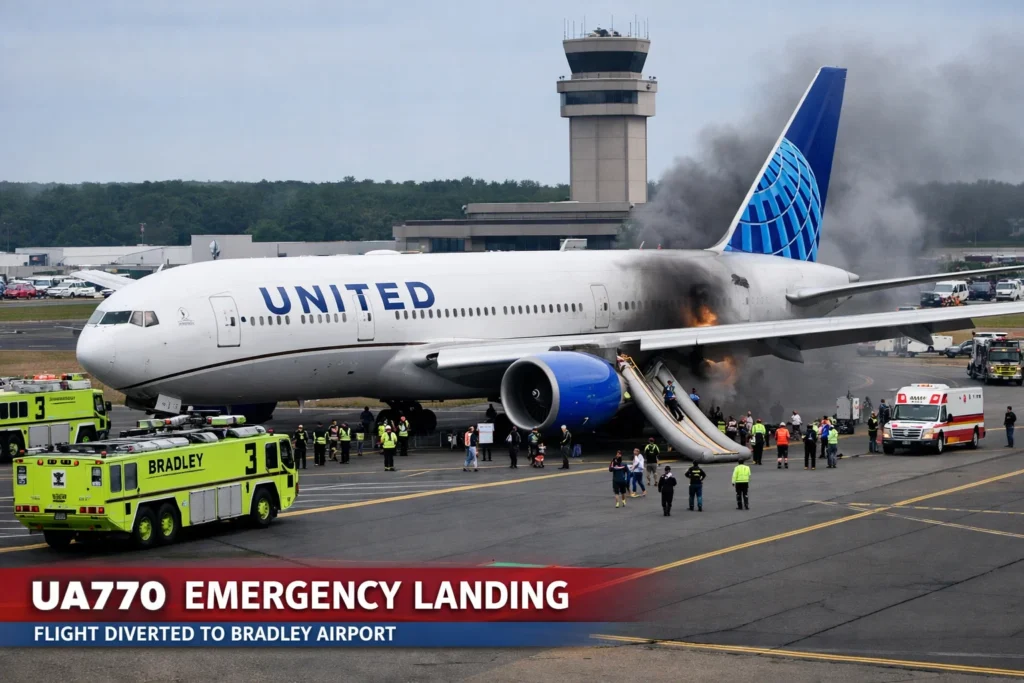
Upon landing at the diversion airport, the scene shifted from airborne chaos to ground-level logistics. Emergency services swarmed the plane, prioritizing the evacuation of the injured flight attendants. Passengers were left on the tarmac or in holding areas, grappling with the adrenaline crash and the reality of what had just happened. United Airlines faced the immediate challenge of not only getting these passengers to their final destination but also managing the trauma. For frequent flyers, the experience served as a jarring reminder that the statistics of safety are little comfort when you are living through the anomaly.
United Airlines’ Response and Crisis Management
In the wake of the United Airlines flight UA770 emergency diversion, the airline’s response was closely watched by the public and industry analysts alike. Crisis management in the airline industry is a delicate dance. An airline must show compassion for the victims while simultaneously cooperating with investigators and reassuring the broader public that it is safe to fly. United’s initial communications focused on the safety of the passengers and the professionalism of the crew, a standard but necessary approach.
However, as the NTSB report highlighted the specific cause of the incident—controller error—the narrative shifted. United was technically the victim of an external system failure, not a failure of their own pilots or maintenance. This allowed the airline to position itself as an advocate for improved safety measures, supporting the NTSB’s recommendations and calling for a review of ATC procedures. For the injured flight attendants, the airline faced a longer-term public relations and ethical challenge. Ensuring that these crew members received top-tier medical care and support was paramount, not just for their well-being but for the morale of the entire United workforce.
The airline also had to manage the overlapping crises. With the Denver engine failure happening in close temporal proximity, United’s communications team was fighting on two fronts. They had to differentiate between the two incidents in the public mind—one a manufacturing/maintenance issue (Denver) and one an operational/communication issue (Newark). Successfully navigating this required a consistent message: “Safety is our highest priority.” While this phrase is often dismissed as corporate jargon, in times of crisis, repeating it consistently helps to anchor the brand to its core promise, even as investigators dig into the specifics of what went wrong.
The Bigger Picture: Aviation Safety in the Modern Age
The events surrounding United 770 serve as a powerful microcosm of the challenges facing modern aviation. We have built an incredibly safe system, but that safety relies on the perfect interaction of technology, procedure, and human performance. The UA770 incident shows what happens when the human element falters. It wasn’t a massive technological failure; it was a single person, distracted by “other coordination,” failing to pass on a message. This highlights a vulnerability in the system that automation cannot easily fix.
Furthermore, the comparison with the Denver engine failure illustrates the diversity of risks. Airlines today must manage “old” risks, like metal fatigue in engines (a problem that has existed since the dawn of jet travel), alongside systemic risks, like communication breakdowns. They must also contend with emerging threats, such as the increasing severity of clear-air turbulence linked to climate change. The “safest era of flying” is a statistical reality, but it is also a delicate balance that requires constant vigilance.
For passengers, the takeaway is twofold. First, it reinforces the absolute necessity of wearing seatbelts at all times when seated. The image of an infant being thrown from someone’s arms on UA770 is a haunting testament to this rule. Second, it serves as a reminder that the system, while robust, is run by humans. And humans, even highly trained air traffic controllers, can have bad days. The industry’s goal is to build redundancies that catch those human errors before they lead to injuries. The NTSB report on UA770 is a blueprint for building those redundancies more strongly.
Conclusion
The United Airlines flight UA770 emergency diversion stands as a significant event in recent aviation history, not because of its scale, but because of its implications. It was an accident caused not by a storm or a mechanical gremlin, but by a moment of human inattention in a control tower that had a domino effect on the lives of hundreds of people in the sky. The severe injuries sustained by the flight attendants are a sobering reminder of the physical dangers that lurk in the seemingly empty sky.
As we look back on the incident, the story is one of heroism and failure. The failure was the missed warning. The heroism was the response of a battered crew who, even while injured, prioritized the safety of their passengers. For travelers, it reinforces the importance of that simple click of the seatbelt. For the industry, it is a call to never stop refining the human systems that guide our planes, ensuring that when a pilot calls out a warning, someone is always listening.
Frequently Asked Questions
What exactly caused the United Airlines flight UA770 emergency diversion?
The diversion was caused by a sudden and severe bout of turbulence during the flight’s descent into Newark. An investigation by the National Transportation Safety Board (NTSB) later revealed that an air traffic controller failed to relay a pilot weather report (PIREP) from another aircraft that had just encountered turbulence in the same area. This warning could have allowed the crew of UA770 to better prepare the cabin and potentially avoid the worst of the turbulence.
How severe were the injuries on flight UA770?
The injuries were very severe, particularly among the flight crew. The NTSB report detailed that three flight attendants suffered significant trauma. One sustained a spinal fracture after being thrown into the ceiling, while two others suffered a shattered femur and major head trauma, losing consciousness. An infant being held and an adult in the lavatory were also thrown from their positions.
Was this incident related to the United Airlines engine explosion in Denver?
No, the two incidents were completely unrelated except for involving the same airline. The United Airlines flight UA770 emergency diversion was caused by turbulence and an air traffic control error. The Denver incident, involving another United Boeing 777, was caused by a catastrophic engine failure due to a broken fan blade suffering from metal fatigue. They occurred close together in time but were separate events with different causes.
What is a PIREP, and why is it important?
A PIREP, or Pilot Weather Report, is a real-time report of weather conditions encountered by an aircraft in flight. It is a crucial safety tool because it provides information that weather radar on the ground or in the cockpit cannot always detect, such as the intensity of turbulence or icing. Controllers are required to share these reports with other aircraft in the area to give them a warning of potential hazards ahead.
What happened to the air traffic controller involved?
While the NTSB report detailed the controller’s failure to follow procedures, noting they were “completing other coordination” and missed the initial PIREP, the NTSB’s mandate is to investigate for safety purposes, not to assign legal blame or determine disciplinary action. The report is used to recommend safety improvements, but any personnel actions regarding the controller would be handled by the FAA or their employer.
How does this incident compare to the 2018 Southwest Airlines engine failure?
Both incidents highlight the dangers of uncontained engine failures and flying debris, but they had different outcomes. In the 2026 Denver incident (similar to the 2018 event), fan blade failure led to an engine breakup. The 2018 Southwest accident was deadlier because debris broke a window, leading to a passenger’s death. The UA770 incident was different, focusing on internal cabin injuries from turbulence. However, all three cases led to significant safety reviews by the NTSB and FAA regarding maintenance, inspection, and communication protocols.
As a passenger, how can I stay safe during flights?
The most important lesson from the UA770 incident is to always wear your seatbelt whenever you are seated. Turbulence can occur without any warning, even when the seatbelt sign is off. For parents, this also means securing children in their own FAA-approved child restraint systems rather than holding them in their lap, as an adult’s arms cannot protect a child in severe turbulence.