
The Specific Heat Formula Demystified: Your Complete Guide to Thermal Energy Calculations
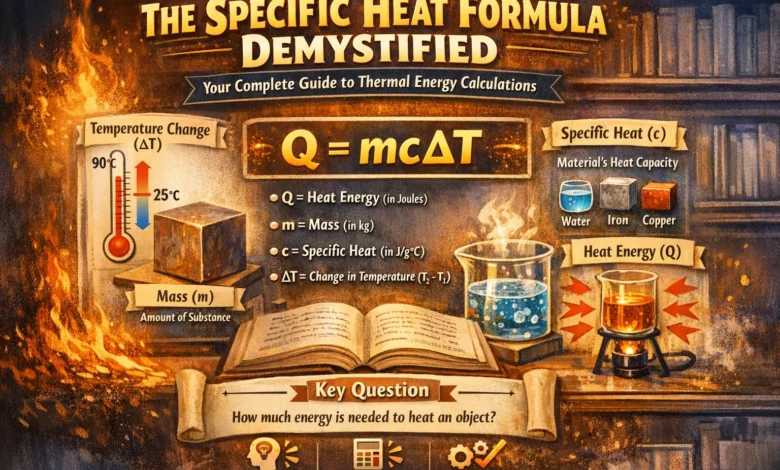
Specific Heat Formula: Have you ever burned your hand on a metal spoon left in a hot pot of soup, while the soup itself—despite being the same temperature—only gave you a gentle warmth? Or perhaps you’ve noticed how the sand at the beach is scorching hot by midday while the ocean water remains refreshingly cool. These everyday experiences are not just random quirks of nature; they are perfect demonstrations of a fundamental concept in physics and chemistry: specific heat. At the heart of understanding these phenomena lies a simple yet incredibly powerful tool known as the specific heat formula.
Whether you are a student cramming for an exam, a hobbyist tinkering with projects, or just a curious mind trying to understand the world, the specific heat formula is your gateway to predicting how substances respond to heat. It tells us exactly how much energy we need to pump into a material to change its temperature, or conversely, how much energy it will release as it cools down. This isn’t just academic jargon; it’s the science behind your kitchen, your car’s cooling system, and even global weather patterns.
In this comprehensive guide, we are going to strip away the confusion surrounding the specific heat formula. We’ll start with the basics, move through the derivation and its various forms, and then explore the fascinating real-world applications that make this equation so vital. By the end, you won’t just be able to plug numbers into the specific heat formula; you’ll understand the “why” behind the calculation and appreciate the thermal dance of atoms and molecules that governs our universe.
What is Specific Heat? Defining the Core Concept
Before we dive headfirst into the equation, we need to get crystal clear on what we are actually talking about. The term “specific heat” might sound intimidating, but it’s a fairly straightforward concept. In the simplest terms, specific heat is a measure of how much a substance resists changing its temperature when it is heated or cooled. Technically, it is defined as the amount of heat energy required to raise the temperature of one unit of mass of a substance by one degree Celsius (or one Kelvin).
Think of it as a material’s thermal laziness. A substance with a high specific heat, like water, is very “lazy” – it takes a lot of energy to get it to warm up, and once it is warm, it takes a long time to cool down. A substance with a low specific heat, like most metals, is “energetic” – it heats up quickly and cools down just as fast. This property is intrinsic to the material itself; it doesn’t matter if you have a bucket of water or an ocean, the specific heat of pure water is always approximately 4,184 Joules per kilogram per degree Celsius (J/kg°C).
It’s crucial here to distinguish specific heat from the broader concept of heat capacity. While often used interchangeably in casual conversation, they are different. Heat capacity (C) refers to the amount of heat needed to raise the temperature of an entire object by one degree. Specific heat (c), on the other hand, is normalized per unit mass. So, a massive battleship has a huge heat capacity (it takes a ton of energy to warm it up), but if it’s made of steel, the steel itself has a relatively low specific heat. The specific heat formula we will explore uses this intensive property (c) to make our calculations independent of the type of material but dependent on how much of it we have.
Deriving the Specific Heat Formula: Q = mcΔT
Now, let’s get to the heart of the matter. The standard specific heat formula is elegantly simple, but it’s helpful to see where it comes from. Imagine you are heating a pot of water on a stove. Intuitively, you know two things: First, the more water you have in the pot, the longer it takes to boil. Second, the hotter you want the water to get, the longer you have to leave it on the stove. This intuition is exactly what the formula captures.
Scientists observed that the amount of heat energy (Q) required is directly proportional to two factors: the mass of the substance (m) and the change in its temperature (ΔT). We can write this as:
- Q ∝ m (More mass needs more heat)
- Q ∝ ΔT (Greater temperature change needs more heat)
When we combine these proportionalities, we get Q ∝ mΔT. To turn this proportionality into an equation, we introduce a constant of proportionality. This constant is the specific heat capacity (c), which is unique to each material. Thus, we arrive at the famous specific heat formula:
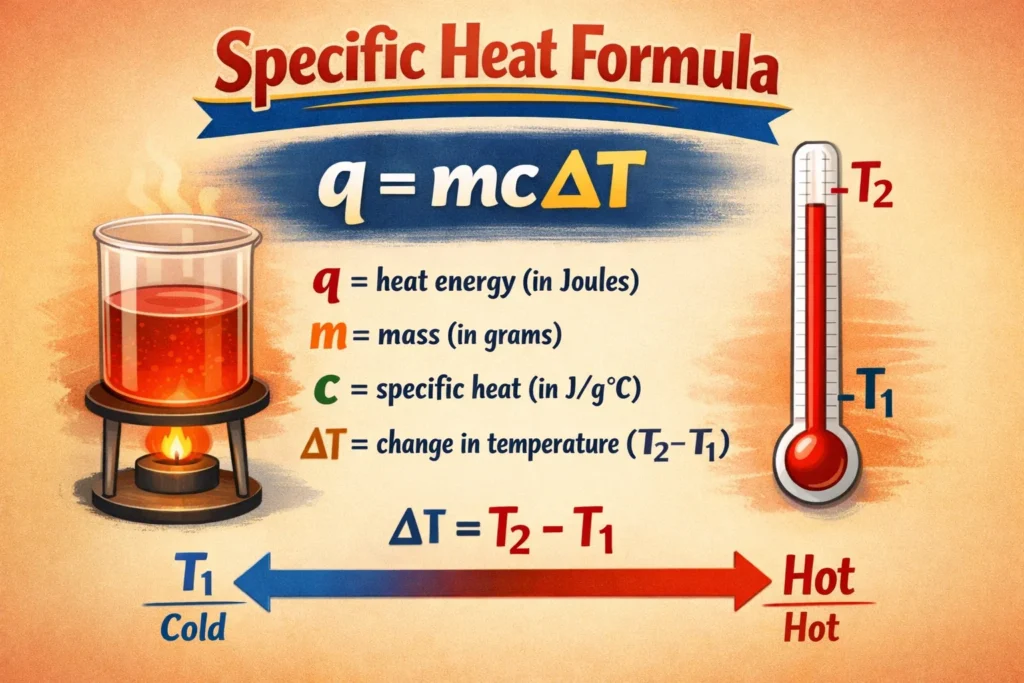
Q = m * c * ΔT
Where:
- Q is the heat energy absorbed or released (in Joules, J)
- m is the mass of the substance (in kilograms, kg, or grams, g)
- c is the specific heat capacity (in J/kg°C or J/g°C)
- ΔT is the change in temperature (T_final – T_initial) in °C or K
It is important to note that a change of 1°C is exactly equal to a change of 1 K, so you can mix these units without conversion. This specific heat formula is the workhorse of thermal physics, allowing us to calculate any one of these four variables if we know the other three.
The Sign of Q: Gaining and Losing Heat
One of the most practical aspects of using the specific heat formula is understanding what the sign of your answer means. The variable Q represents the energy transfer, and just like money moving into or out of a bank account, the direction matters.
If you are heating something up, you are adding energy to the system. In this case, the final temperature is higher than the initial temperature, so ΔT is positive. Consequently, your calculated Q will be a positive number (+Q). This indicates an endothermic process from the perspective of the substance you are heating—it is gaining thermal energy.
Conversely, when an object cools down, it is losing energy to its surroundings. The final temperature is lower than the initial temperature, making ΔT negative. When you plug this into the specific heat formula, your result for Q will be a negative number (-Q). This negative sign is crucial in thermodynamics because it signifies an exothermic process for the object; it is releasing heat. In calorimetry experiments, for instance, if you see a temperature increase in the water, you know the reaction was exothermic and the Q for the water is positive, meaning the Q for the reaction is negative.
Specific Heat for Solids: The Dulong-Petit Insight
When we apply the specific heat formula to solid elements, an interesting pattern emerges that puzzled scientists in the 19th century. If you measure the specific heat of various solid metals in J/kg°C, you get a wide range of numbers. For example, copper is about 385 J/kg°C, while lead is only about 128 J/kg°C. This seems to suggest they are wildly different. But physicists Pierre Louis Dulong and Alexis Thérèse Petit looked at it from a different angle: instead of per kilogram, they looked at it per mole.
What Dulong and Petit discovered in 1819 is that when you multiply the specific heat of a solid element by its atomic mass (to get the heat capacity per mole), you get a nearly constant value. This value is approximately 25 J/mol°C, which is roughly equal to 3R, where R is the ideal gas constant. This is known as the Law of Dulong and Petit.
Let’s test this with the numbers above:
- Copper: Atomic mass = 63.5 g/mol. Molar heat capacity = 0.385 J/g°C * 63.5 g/mol ≈ 24.4 J/mol°C.
- Lead: Atomic mass = 207 g/mol. Molar heat capacity = 0.128 J/g°C * 207 g/mol ≈ 26.5 J/mol°C.
They are remarkably similar! This law was a crucial clue in the development of atomic theory, suggesting that each atom in a solid, regardless of its mass, contributes roughly the same amount to the energy storage of the material. While the law breaks down at very low temperatures (a problem later solved by the Einstein-Debye model), it’s a great illustration of how the specific heat formula can be used to reveal deep physical truths.
Specific Heat for Gases: Cp and Cv
Things get a bit more complex when we move from solids and liquids to gases. For gases, the way we apply the specific heat formula depends heavily on the conditions of the experiment. This is because gases are compressible, and when you heat a gas, it can expand and do work. Therefore, we have two distinct definitions of specific heat for gases: specific heat at constant volume (Cv) and specific heat at constant pressure (Cp).
The specific heat at constant volume, Cv, is the amount of heat required to raise the temperature of a gas when it is held in a rigid container so its volume cannot change. Under these conditions, all the heat added goes directly into increasing the internal energy (the kinetic energy of the molecules) of the gas, which raises its temperature. For a monatomic ideal gas (like helium or argon), Cv is approximately (3/2)R per mole.
The specific heat at constant pressure, Cp, is always larger than Cv for a given gas. Why? Because when you heat a gas at constant pressure (like in a cylinder with a movable piston), it expands. To expand against the external pressure, the gas must do work. Therefore, you have to supply extra heat energy—on top of what you put in for Cv—to account for this work. For a monatomic ideal gas, Cp is approximately (5/2)R per mole. The ratio of these two, γ = Cp/Cv, is an important parameter in thermodynamics and fluid dynamics. When using the specific heat formula for gases, you must specify whether you are using Cp or Cv, or your calculations will be wrong.
Practical Applications: Where the Formula Comes to Life
The true beauty of the specific heat formula is its immense practical utility. It is not just a classroom exercise; it is an engineering and environmental tool used daily across countless industries. Understanding the specific heat of materials allows us to design, predict, and control thermal environments.
In engineering, the specific heat formula is critical for thermal management. Car radiators use a mixture of water and coolant precisely because water has a very high specific heat. It can absorb a tremendous amount of waste heat from the engine without its temperature rising dramatically, effectively carrying that heat to the radiator where it can be released. Similarly, engineers designing electronics must calculate the heat sinks needed for CPUs. By using Q = mcΔT, they can determine how massive a copper or aluminum heat sink needs to be to absorb the heat generated by the processor and keep it below its maximum operating temperature.
In environmental science, the specific heat formula explains our climate and weather patterns. The enormous specific heat of water is why coastal areas have milder climates than inland areas. The ocean acts as a massive heat reservoir, absorbing heat in the summer and slowly releasing it in the winter. This is also the mechanism behind land and sea breezes. During the day, the land (low specific heat) heats up faster than the sea (high specific heat). The warm air over the land rises, and cooler, denser air from the sea rushes in to replace it—creating a sea breeze. At night, the process reverses as the land cools faster, creating a land breeze. These are direct, large-scale consequences of the principles embedded in the specific heat formula.
Worked Examples: Putting the Formula to Use
The best way to truly master the specific heat formula is to work through some examples. Let’s look at a few scenarios that cover the different ways the equation Q = mcΔT can be used.
Example 1: Calculating Heat Required
How much energy is needed to heat a 2.5 kg block of aluminum from 15°C to 75°C? (Specific heat of aluminum, c = 900 J/kg°C)
We can plug these values directly into the specific heat formula:
Q = m * c * ΔT
Q = (2.5 kg) * (900 J/kg°C) * (75°C – 15°C)
Q = (2.5 kg) * (900 J/kg°C) * (60°C)
Q = 135,000 J or 135 kJ
So, you would need to supply 135,000 Joules of energy.
Example 2: Calculating Heat Released
A 150.0 gram sample of copper cools from 120.0°C to 25.0°C. How much heat is released? (Specific heat of copper, c = 0.385 J/g°C)
Again, we use Q = mcΔT.
Q = (150.0 g) * (0.385 J/g°C) * (25.0°C – 120.0°C)
Q = (150.0 g) * (0.385 J/g°C) * (-95.0°C)
Q = -5486.25 J ≈ -5486 J
The negative sign is crucial here. It tells us that this amount of energy is leaving the copper and entering the surroundings.
Example 3: Finding Specific Heat
If adding 960 J of heat to 50 g of a substance increases its temperature from 30°C to 40°C, what is its specific heat?
Here, we need to rearrange the specific heat formula to solve for c: c = Q / (m * ΔT)
c = 960 J / (50 g * (40°C – 30°C))
c = 960 J / (50 g * 10°C)
c = 960 J / 500 g°C
c = 1.92 J/g°C
By comparing this value to known specific heats, we could potentially identify the mystery substance.
Common Substances and Their Specific Heats
To give you a practical reference, here is a table of specific heat capacities for common materials. Notice the standout value for water, which is why it’s so exceptional at regulating temperature.
| Substance | Specific Heat (J/kg°C) | Specific Heat (J/g°C) |
| Water (liquid) | 4186 | 4.186 |
| Ice (at 0°C) | ~2100 | ~2.1 |
| Steam (at 100°C) | ~2080 | ~2.08 |
| Aluminum | 900 | 0.900 |
| Copper | 385 | 0.385 |
| Iron / Steel | 450 | 0.450 |
| Lead | 128 | 0.128 |
| Ethanol | 2440 | 2.44 |
| Air | ~1005 | ~1.005 |
This table helps visualize the concept we discussed earlier: metals (low values) heat up and cool down quickly, while water (high values) is resistant to temperature change.
Conclusion
The specific heat formula, Q = mcΔT, is far more than just an equation to memorize for a test. It is a lens through which we can understand the thermal behavior of the world around us. From the simple act of cooking pasta to the complex engineering of spacecraft re-entering the atmosphere, this fundamental relationship governs how energy moves and changes the state of matter. We’ve seen how it straightforwardly applies to solids and liquids, and how it requires a bit more nuance when dealing with gases through Cp and Cv.
By understanding the derivation, the meaning of the variables, and the sign conventions, you now have the tools to calculate heat transfer in countless scenarios. Whether you are determining the cooling rate of a cup of coffee or the heating requirements for an industrial furnace, the specific heat formula is your starting point. It connects the microscopic world of jiggling atoms to the macroscopic world of temperature readings, proving that even the most complex thermal phenomena can often be captured in a simple, elegant, and profoundly useful equation.
Frequently Asked Questions
What is the difference between specific heat and heat capacity?
Heat capacity (C) is the amount of heat required to raise the temperature of an entire object by one degree Celsius. Its units are J/°C. Specific heat (c) is the amount of heat required to raise the temperature of one unit of mass (like one kilogram or one gram) of a substance by one degree Celsius. Its units are J/kg°C or J/g°C. Specific heat is an intrinsic property of the material, while heat capacity depends on the object’s mass.
What units should I use in the specific heat formula?
The specific heat formula is flexible, but you must be consistent. If you use mass in kilograms (kg), specific heat should be in J/kg°C, and Q will be in Joules (J). If you use mass in grams (g), specific heat should be in J/g°C, and Q will be in Joules. A common pitfall is mixing kg and J/g°C, which will give you a wrong answer by a factor of 1000. Always check your units before calculating.
Why does water have such a high specific heat?
Water’s high specific heat is due to the strong hydrogen bonds between its molecules. When you add heat to water, a significant portion of that energy goes into breaking or weakening these hydrogen bonds rather than increasing the kinetic energy (and thus the temperature) of the water molecules. This makes water an excellent thermal buffer, which is essential for regulating Earth’s climate and our own body temperatures.
What is the difference between Cp and Cv?
Cp and Cv are specific heats for gases under different conditions. Cv (specific heat at constant volume) is the heat required when the gas is heated in a rigid container where it cannot expand. All heat goes into raising the gas’s temperature. Cp (specific heat at constant pressure) is the heat required when the gas is heated and allowed to expand against the atmosphere. Cp is always larger than Cv because it includes the extra energy needed for the gas to do the work of expanding.
Can I use the specific heat formula if a substance is changing phase?
No, the formula Q = mcΔT only applies when the substance is changing temperature within a single phase (solid, liquid, or gas). During a phase change (like melting ice or boiling water), the temperature remains constant even though heat is being added. This energy is called latent heat. You would use the latent heat formula (Q = mL) for that part of the process, where L is the latent heat of fusion or vaporization.
How is the specific heat formula used in calorimetry experiments?
In calorimetry, we use the specific heat formula to track energy transfer. For example, if a hot object is placed into cool water inside an insulated container (a calorimeter), the heat lost by the object (-Q_object) equals the heat gained by the water (+Q_water). By measuring the temperature change of the water and using Q = mcΔT for the water, we can calculate the amount of heat transferred. This value can then be used with the mass and temperature change of the object to determine its specific heat.