
Remembering Leanne Kaun: The Life and Legacy of Walton Goggins’ First Wife
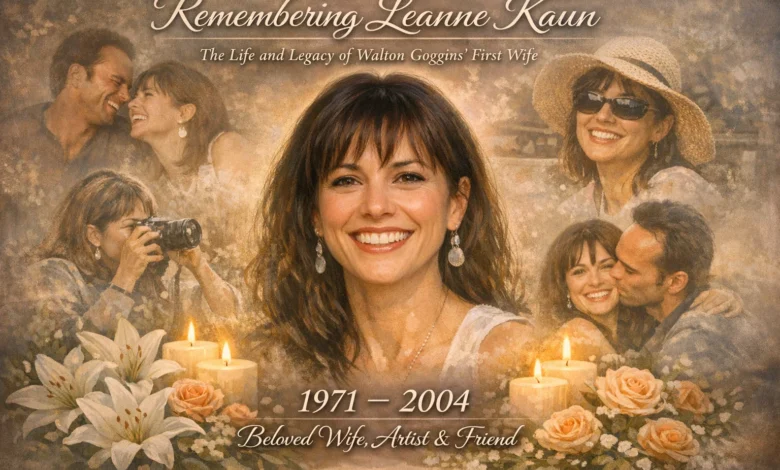
Leanne Kaun: In the landscape of Hollywood stories, some are filled with glitz and glamour, while others carry a deeper, more profound weight. The story of Leanne Kaun falls squarely into the latter category. Though she lived outside the traditional spotlight of the entertainment industry, her life and tragic death left an indelible mark on those who knew her—and on the actor who would go on to become one of the most respected character actors of his generation.


Leanne Kaun, known to many as Leanne Goggins during her marriage to actor Walton Goggins, was a Canadian entrepreneur who built a successful business doing what she loved most: caring for animals. Her journey from a sickly childhood in New Brunswick to becoming the owner of one of the largest pet care firms in Los Angeles’ prestigious Laurel Canyon neighborhood is a testament to resilience, passion, and the determination to build something meaningful.
But her story is also one of profound sadness—a reminder that success and outward happiness don’t always reflect internal reality. In November 2004, Leanne Kaun died by suicide at the age of 37, leaving behind a legacy that would shape Walton Goggins’ life for decades to come. As Goggins experiences a career renaissance with his acclaimed role in The White Lotus, the memory of his first wife has resurfaced in interviews, offering new insights into the woman she was and the grief he carried.
This article seeks to honor Leanne Kaun not merely as a footnote in a celebrity biography but as a complete person—a daughter, a sister, an entrepreneur, an animal lover, and a woman whose struggles with mental health were ultimately too heavy to bear. In doing so, we hope to provide a comprehensive, respectful tribute that goes beyond the headlines to understand who Leanne really was.
| Aspect | Details About Leanne Kaun |
| Full Name | Leanne Knight Goggins (née Kaun) |
| Date of Birth | March 19, 1967 |
| Place of Birth | New Brunswick, Canada |
| Date of Death | November 12, 2004 |
| Age at Death | 37 years old |
| Parents | Robert Brian “Bob” Knight (father), Peggy Kaun (mother), Arnold Kaun (stepfather) |
| Siblings | Jay (brother) |
| Profession | Dog Trainer, Business Owner |
| Notable Achievement | Founder of Canyon Dog Walking in Laurel Canyon, CA |
| Spouse | Walton Goggins (m. 2001–2004, separated at time of death) |
| Burial Site | Rocky View Garden of Peace Cemetery, Calgary, Alberta |
Early Life in New Brunswick: A Childhood of Challenges
Leanne Kaun entered the world on March 19, 1967, in Fredericton, New Brunswick, Canada, born to Robert Brian “Bob” Knight and Peggy Knight. From her very first days, life presented her with obstacles that would shape her character and worldview in profound ways. She was born with jaundice, a condition that causes yellowing of the skin and eyes due to excess bilirubin in the blood, and for Leanne, this wasn’t a temporary newborn condition that quickly resolved.
The jaundice triggered recurring infections throughout her childhood, making her a sickly youngster who missed significant amounts of school. Her parents had to monitor her diet strictly, eliminating certain foods that could exacerbate her condition. Hospital visits became routine rather than exceptional. The financial strain on her family was considerable, as medical bills accumulated and both parents worked to provide the care she needed.
Despite these challenges, or perhaps because of them, Leanne developed a resilience that would serve her well throughout life. She learned to endure discomfort, to persevere when others might have given up, and to find joy in small moments. Friends from her Canadian years remember her as quiet but determined—not the loudest kid in class but certainly one of the most observant.
Her parents eventually separated, and her mother, Peggy, later married Arnold Kaun, whose surname Leanne would carry into adulthood. The family was raised in a Christian household, with faith providing a framework for navigating life’s difficulties. Leanne also had a brother named Jay, with whom she shared the bond of growing up in a family that had weathered its share of storms.
The Animal Lover: Finding Passion Despite Limitations
Perhaps the most defining characteristic of young Leanne Kaun was her profound love for animals. Even as a child dealing with health limitations, she found herself drawn to the creatures that shared her world. There was just one problem: her compromised immune system meant that having pets was considered too risky by her doctors.
So Leanne did the next best thing. She watched neighborhood dogs from her window, learning their routines, their personalities, their quirks from a distance. She’d spend recess reading about animals or sketching them in notebooks. Classroom pets—hamsters, fish, the occasional visiting therapy dog—became the focus of her attention and affection.
This early deprivation of animal companionship didn’t diminish her passion—it intensified it. She developed an almost intuitive understanding of animal behavior, studying them as closely as any scientist might. Her elementary school teachers noticed this gift, commenting on her natural ability to connect with any creature placed in her care.
As she grew into her teenage years, her health gradually improved. The infections became less frequent. Her doctors relaxed restrictions. And finally, Leanne could begin to live the dream she’d been nurturing from behind that window: she could work with animals.
Education and the Path to Independence
Details about Leanne Kaun’s formal education remain somewhat private, which aligns with her generally low-profile approach to life. What we do know is that she completed elementary and high school despite the absences caused by her health issues, demonstrating a commitment to her education that mirrored her determination in other areas of life.
She went on to earn a degree—the specific field isn’t widely documented—and immediately knew what she wanted to do with her training. While other graduates might have pursued corporate careers or traditional professional paths, Leanne followed her heart straight back to animals.
Her education in pet care and training wasn’t formalized in the way we might think of professional degrees today. Instead, she combined her natural gifts with hands-on experience, learning the nuances of animal behavior through direct interaction and study. This practical approach would serve her well when she eventually launched her own business.
The Move to Los Angeles: Chasing a Dream
Los Angeles in the late 1990s was a city of dreamers, most of them chasing fame in the entertainment industry. Leanne Kaun’s dream was different. She saw something that others overlooked: a city full of busy professionals with beloved dogs and no time to care for them properly.
The Hollywood Hills area, particularly the bohemian Laurel Canyon neighborhood, was packed with directors working twelve-hour days, actors rushing from audition to audition, and producers stuck in endless meetings. They all had one thing in common—beautiful dogs that needed exercise, socialization, and genuine attention that their busy owners couldn’t provide.
Leanne recognized this gap in the market and set out to fill it. She started small, building her clientele through word-of-mouth and personal referrals. A friend of a friend needed someone reliable. Then another client. Then another. Her approach was simple but effective: treat every dog as if it were her own, provide personalized attention, and be absolutely reliable in a city where reliability was hard to find.
What set Leanne apart wasn’t just her work ethic—it was her genuine connection with animals. She didn’t just walk dogs; she studied them. She understood that each dog had a unique personality, unique needs, and unique preferences. She created individualized routines that maximized their physical exercise and mental stimulation. Clients quickly realized that their dogs weren’t just being walked—they were being genuinely cared for.
Building Canyon Dog Walking: An Entrepreneurial Success
Leanne Kaun’s business, Canyon Dog Walking, grew from a one-woman operation into one of the largest pet care firms in the Hollywood Hills area. This wasn’t just a side hustle or a way to make ends meet—it was a legitimate entrepreneurial success story in one of the most competitive markets in America.
Her client list grew to include notable names, including Liberty, the official mascot of Canyon News. Such high-profile clients didn’t just provide revenue—they provided credibility. When other pet owners saw that Liberty’s caregivers trusted Leanne, they wanted the same quality of care for their own animals.
One former client recalled how Leanne noticed their typically energetic golden retriever seemed lethargic during walks. She suggested a veterinary visit, which revealed early-stage Lyme disease. Leanne Kaun’s attention to detail and genuine concern for the animals in her care literally saved that dog’s life.
But Leanne’s impact extended beyond her paying clients. She regularly took on rescue dogs that nobody else wanted to walk—animals with behavioral issues, histories of abuse, or the kind of challenges that made them difficult to handle. She volunteered at local shelters, helping to socialize dogs that needed extra patience to become adoptable.
Her home in Laurel Canyon became something of a rotating sanctuary. She’d foster dogs between permanent homes. She’d provide free care for clients experiencing financial hardship. This wasn’t marketing or performative generosity—it was simply who Leanne was at her core.
In many ways, Leanne Kaun was ahead of her time. The pet care industry has since exploded, with companies like Rover and Wag! scaling the exact model she built at the neighborhood level. She understood that in a city where schedules are chaotic and unpredictable, pet owners need reliability, professionalism, and genuine care. She delivered on all three.
The Meeting That Changed Everything: Walton Goggins
In 2000, while filming the Jackie Chan and Owen Wilson action-comedy Shanghai Noon in Canada, Walton Goggins met Leanne Kaun through mutual friends in the entertainment industry circle. She was visiting family in her home country. He was there for work. Neither could have known how profoundly their lives would intertwine.
Walton Goggins, born in Birmingham, Alabama, in 1971, had been grinding in Hollywood for years. He’d had some success—recurring roles, character parts—but hadn’t yet become the name he’d establish with The Shield and later Justified. Leanne, meanwhile, was building her business and living a life entirely outside the entertainment bubble.
The connection between them was immediate but not flashy. Walton wasn’t the type for grand romantic gestures (at least not yet). Leanne wasn’t looking for a Hollywood romance. They simply clicked in a way that felt natural and inevitable.
What drew Walton to Leanne? By his own accounts over the years, it was her groundedness. In an industry full of people desperate for fame and validation, she was running a dog walking business. She didn’t care about red carpets or premieres. She cared about whether her canine clients got enough exercise and mental stimulation. She was authentic in a town where authenticity is often the first thing sacrificed.
What drew Leanne to Walton? Friends say it was his genuineness. Despite working in entertainment, he retained a Southern charm and authenticity that felt refreshing. He treated service workers with respect. He remembered people’s names. He asked about her business with genuine curiosity rather than polite dismissal. He was, in short, a good man.
Their courtship was brief—just over a year—but intense. Long phone calls when Walton was on location. Leanne is visiting film sets. Walton was learning about dog behavior because it mattered to her. By late 2000, they were serious. In 2001, they were married.
Marriage and Life in Los Angeles
After their wedding, Leanne relocated permanently to Los Angeles, joining Walton in the Laurel Canyon home that would become the center of their life together. On the surface, everything seemed to be falling into place beautifully.
Walton’s career was gaining momentum. He’d landed the role of Detective Shane Vendrell on The Shield, a performance that would earn him critical acclaim and put him on the map as a serious dramatic actor. The show was demanding—long hours, intense material, constant pressure—but it was the kind of breakthrough every actor dreams of.
Leanne, meanwhile, continued to grow her business. Canyon Dog Walking was thriving, and she’d also taken on a role as an adviser to Canyon News, sharing her expertise with the local publication. She had built something meaningful in her new city, establishing herself as a respected entrepreneur in her own right.
Friends described them as a happy couple during these early years. They’d host gatherings at their home, with Leanne’s warmth creating an atmosphere that made guests feel genuinely welcome. Walton would speak of her with obvious affection and pride. They seemed, to outside observers, to have found something special.
But beneath the surface, tensions were developing. Walton’s schedule on The Shield kept him away from home for extended periods. The long hours, the emotional demands of playing such an intense character, the constant pressure of production—it all took a toll. Leanne, who had relocated across the continent to build a life with him, found herself spending increasing amounts of time alone.
Cracks in the Foundation: Marital Struggles
By 2003, the challenges in Leanne and Walton’s marriage had become harder to ignore. Reports suggest that Leanne was unhappy with the amount of time Walton spent working and had begun to feel isolated in Los Angeles. She missed Canada, missed her family, missed the life she’d left behind.
The couple found themselves entangled in conflicts and misunderstandings. Communication, which had come so easily during their courtship, became strained. The very qualities that had drawn them together—his dedication to his craft, her independent spirit—now seemed to push them apart.
A particularly traumatic event in 2003 may have compounded Leanne’s emotional struggles. While walking a dog, she reportedly came upon a dead body—an experience that profoundly disturbed her and may have contributed to the emotional turbulence she was experiencing. For someone already dealing with the stresses of a strained marriage and the isolation of living far from home, such an encounter could have been deeply destabilizing.
Throughout this period, Leanne was also battling chronic depression. This wasn’t a new condition—those who knew her from Canada recalled that she’d always had periods of withdrawal, times when she’d disappear from social contact for weeks at a stretch. But in the pressure cooker of her current circumstances, the depression intensified.
By early 2004, the situation had deteriorated to the point that Leanne was receiving treatment at a mental health clinic near the family’s home. She was trying to get help, trying to find a way through the darkness. But the treatments weren’t providing the relief she desperately needed.
The Separation and Final Days
In November 2004, Leanne made a decision that would set in motion the tragic events to come. She handed Walton divorce papers, formally initiating the end of their marriage. For someone already struggling with depression, the dissolution of her marriage—even if it was troubled—represented another profound loss.
The couple separated. Walton moved out. Leanne remained in their Laurel Canyon home, now alone with her thoughts and her pain.
Just days later, on November 12, 2004, Leanne Kaun went missing. Around 4:00 p.m., she was discovered after jumping from the 17th floor of a high-rise office building in Los Angeles. She did not die immediately from the fall. Emergency responders rushed her to a nearby health clinic, but her injuries were too severe. She succumbed while receiving medical attention. She was 37 years old.
The news sent shockwaves through those who knew her and through the entertainment community that had come to know Walton through his work on The Shield. Cast members from the show attended her funeral, supporting their colleague through an unimaginable loss.
Leanne was laid to rest at the Rocky View Garden of Peace Cemetery in Calgary, Alberta, and returned to the Canadian soil she had missed so deeply during her years in Los Angeles. Her memorial service was held on November 19, 2004, at Hollywood Funeral Home on Santa Monica Boulevard.

Understanding the Tragedy: Mental Health and Its Hidden Struggles
The death of Leanne Kaun Goggins was officially ruled a suicide, the result of her long-standing battle with chronic depression. In the years since, those who knew her have tried to make sense of what happened, to understand how someone with so much apparent success and so many people who loved her could reach such a desperate point.
Her childhood health struggles almost certainly played a role. Research has shown that chronic illness in childhood correlates with higher rates of depression and anxiety later in life. When your nervous system is wired from an early age to expect pain, to anticipate the next crisis, it can be difficult to find a stable emotional footing even when circumstances improve.
The move to Los Angeles, while professionally successful, may have exacerbated these underlying vulnerabilities. Leanne was far from her family, far from the support systems she’d built over a lifetime in Canada. She was living in a city known for its superficiality, its relentless pressure, its casual cruelties—a difficult environment for anyone, let alone someone already struggling.
Her marriage difficulties added another layer of stress. Even when a relationship has problems, its dissolution represents a profound loss—of companionship, of shared dreams, of the future you’d imagined together. For someone with depression, such losses can feel insurmountable.
The traumatic experience of discovering a dead body in 2003 may have been a triggering event that compounded existing vulnerabilities. Trauma has a way of reopening old wounds, of making everything feel more dangerous and uncertain.
What makes Leanne’s story particularly heartbreaking is that she was trying to get help. She was attending a mental health clinic. She was receiving treatment. But the treatments available in 2004 were not what they are today, and for some people, even the best available care isn’t enough to hold back the darkness.
Walton’s Journey Through Grief
For Walton Goggins, Leanne’s death was devastating, from which recovery seemed impossible. In the years since, he has spoken about his grief with a rawness that reveals how deeply the loss affected him.
“I drifted for upwards of three years after that,” he told The Daily Beast in 2019. “It took me a really long time to come back from it. If it weren’t for the people in my life that cared about me, that stepped in and helped me understand that life goes on, I don’t know what would have happened”.
In the immediate aftermath, Walton traveled extensively through South and Southeast Asia—Thailand, Cambodia, Vietnam, India—seeking something he couldn’t name, trying to outrun or process the pain. He acknowledges now that he spent those years “looking for an excuse—not to end it, but certainly putting myself in situations that were questionable”.
The grief was compounded by the circumstances of Leanne’s death. She had handed him divorce papers just days before. The what-ifs—what if he’d been home more, what if he’d recognized the signs, what if things had been different—must have been agonizing. But Walton has never spoken publicly with blame or anger toward Leanne. Instead, he speaks of her with evident love and enduring sadness.
The 2025 Reflections: Thailand and The White Lotus
Twenty years after Leanne’s death, Walton Goggins found himself in a situation that brought the past rushing back. He was filming season three of HBO’s acclaimed series *The White Lotus”—in Thailand.
As he arrived on the first island where the production was based, something felt familiar. Then the production moved to another island, and the recognition became undeniable. “I’ve definitely been on this beach before. I know this boardwalk,” he realized. “And all of the things kept coming back”.
Twenty years earlier, in the immediate aftermath of Leanne’s death, Walton had traveled to Thailand as part of his grief journey. Now he was back on those same beaches, in those same locations, processing emotions that had never fully resolved.
“That’s where I was the very first day I came here, 20 years ago, and in so much … pain, man,” he told GQ. “That’s where we were filming, man—all of the equipment was literally right in front of the hotel that I’d picked 20 years ago on the internet, on this little bitty road in this little bitty neighborhood”.
Standing in those locations, Walton found himself wishing he could travel back in time to comfort his younger self. “I thought, God, I wish I could hug that guy. I wish I could whisper in his ear, You’re going to be okay. Life continues, and it continues for everybody if you can just hold on and lean into it and keep walking the walk that you’re walking, and keep looking for the answers”.
These reflections, shared in 2025 interviews, offer a window into how grief transforms over time. It doesn’t disappear. It doesn’t fully resolve. But it becomes something that can be carried, something that can be integrated into a life that continues forward.
Life After Loss: Walton’s Second Chapter
Six years after Leanne’s death, Walton Goggins found love again. In August 2011, he married filmmaker Nadia Conners, with whom he now shares a son, Augustus, born in February of that same year.
Nadia exists somewhat on the periphery of Hollywood despite her impressive credentials. A graduate of the American University of Paris, she founded Tree Media Group with her sister, Leila Conners Peterson. The company produced The 11th Hour, an environmental documentary written, directed, and produced in collaboration with Leonardo DiCaprio.
The marriage to Nadia and the birth of their son represent Walton’s hard-won return to a full life. But those who know him say he has never forgotten Leanne or stopped carrying the lessons of their time together. Her memory exists alongside his present happiness, not erased by it but integrated into the complex tapestry of his life.
In his 2025 interviews, Walton’s willingness to speak openly about Leanne and about his grief reflects a man who has done the difficult work of processing trauma. He doesn’t hide from the past or pretend it didn’t happen. He carries it with him, using it to inform his present and to connect with others who have experienced similar losses.
Remembering Leanne Kaun: The Woman Behind the Tragedy
In telling Leanne Kaun’s story, it’s essential to remember that she was more than the tragic circumstances of her death. She was a woman of substance, passion, and achievement—someone who built something meaningful with her hands and her heart.
She was the sickly child who refused to let her health limitations define her, who grew into an entrepreneur capable of building one of the most successful pet care businesses in a competitive market.
She was the animal lover who couldn’t have pets as a child and channeled that longing into a career spent caring for creatures who couldn’t care for themselves.
She was the woman who noticed when a dog seemed off, who suggested a vet visit, who literally saved a life through her attentiveness and care.
She was the neighbor who took on rescue dogs nobody else wanted, who fostered animals between permanent homes, and who provided free care to clients going through hard times.
She was the wife who loved deeply, who moved across a continent to build a life with the man she chose, who struggled when that life didn’t match her hopes.
Leanne Kaun was a complete human being—flawed, yes, struggling, yes, but also accomplished, loving, and deeply, genuinely good. Her death is a tragedy precisely because her life had so much value.
The Legacy of Leanne Kaun
What legacy did Leanne Kaun leave behind? It exists in multiple forms, rippling outward in ways she might never have imagined.
There’s the business she built, which continued after her death and served as a model for countless pet care entrepreneurs who followed. The template she created—personalized care, genuine attention, professional reliability—is now standard practice in an industry she helped shape.
There’s the impact on the animals she cared for, the lives she touched directly through her work. Every dog she walked, every rescue she fostered, every shelter animal she socialized carries forward some piece of her compassion.
There’s the influence on the people who knew her—friends who remember her warmth, clients who recall her dedication, family members who carry her memory.
And there’s the effect on Walton Goggins, who has spoken openly about how Leanne’s death and his subsequent grief shaped him as a person and as an artist. The depth he brings to his performances, the vulnerability he’s willing to show on screen—some of that undoubtedly comes from having loved and lost most profoundly.
In his 2025 interviews, Walton’s reflections on Leanne serve as a kind of ongoing memorial. By speaking her name, by sharing his memories, by acknowledging the pain and the love that still exists twenty years later, he ensures that Leanne Kaun is not forgotten.
Lessons on Mental Health and Suicide Prevention
Leanne Kaun’s story, while deeply personal, also carries broader lessons about mental health and suicide prevention that remain urgently relevant.
Her struggles with depression were not a character flaw or a moral failing. They were a medical condition, as real and as serious as any physical illness. The fact that she sought treatment, that she was working with a mental health clinic, demonstrates that she was trying to fight—but that sometimes, even the best efforts aren’t enough.
Her childhood health challenges likely contributed to her vulnerability. When we understand mental health as something shaped by a lifetime of experiences, we can better identify those who might need additional support.
The traumatic event she experienced—discovering a dead body—may have been a trigger that compounded existing struggles. Trauma has cumulative effects, and what might seem manageable in isolation can become overwhelming when layered onto existing vulnerabilities.
The isolation she felt in Los Angeles, far from her support systems, may have made everything harder to bear. Connection matters. Community matters. Having people who truly know you and can recognize when you’re struggling matters enormously.
In the years since Leanne’s death, conversations about mental health have evolved significantly. There’s less stigma, more openness, and greater understanding. But there’s still so much work to be done. Still, so many people are suffering in silence. Still, so many families are devastated by losses that might have been prevented.
If Leanne’s story can do anything positive, perhaps it can encourage someone who’s struggling to reach out, to ask for help, to believe that things can get better. And perhaps it can encourage the rest of us to check in on the people we love, to ask the hard questions, to be present in ways that might make a difference.
“I drifted for upwards of three years after that. It took me a really long time to come back from it. If it weren’t for the people in my life who cared about me, who stepped in and helped me understand that life goes on, I don’t know what would have happened.” — Walton Goggins on life after Leanne’s death.
Conclusion
The story of Leanne Kaun is not an easy one to tell or to read. It involves pain, loss, and questions that will never be fully answered. But it’s a story worth telling because Leanne herself was worth remembering.
She was a woman who overcame childhood illness to build a successful business doing what she loved. She was an entrepreneur who saw an opportunity and seized it, creating something of genuine value in a competitive market. She was an animal lover whose compassion extended to the most vulnerable creatures. She was a wife who loved deeply, even when love wasn’t enough to overcome her struggles. She was a human being of worth and dignity, whose life mattered and whose death left a void that can never be filled.
For Walton Goggins, the memory of Leanne Kaun remains alive, integrated into the person he has become. His willingness to speak about her, to share his grief and his growth, ensures that she is not forgotten. And for those of us who never knew her, learning her story offers an opportunity to reflect on our own lives, our own relationships, our own mental health.
If there’s a lesson to carry forward from Leanne’s life, perhaps it’s this: be kind, be present, be attentive to the people around you. You never know what battles someone is fighting. You never know what difference a single moment of genuine connection might make.
Leanne Kaun deserved better than the ending she got. But her life—not just her death—is what deserves to be remembered. A woman who loved animals, who built something meaningful, who touched the lives of those around her. That is the legacy worth honoring.
“I wish I could hug that guy. I wish I could whisper in his ear, You’re going to be okay. Life continues, and it continues for everybody if you can just hold on and lean into it and keep walking the walk that you’re walking, and keep looking for the answers.” — Walton Goggins, reflecting on his younger self after Leanne’s death.
Frequently Asked Questions About Leanne Kaun
Who was Leanne Kaun?
Leanne Kaun, also known as Leanne Goggins during her marriage, was a Canadian entrepreneur and animal lover who founded Canyon Dog Walking, a successful pet care business in Los Angeles’ Laurel Canyon neighborhood. She was the first wife of actor Walton Goggins and died by suicide in November 2004 at the age of 37.
What was Leanne Kaun’s profession?
Leanne Kaun was a dog trainer and business owner. She founded Canyon Dog Walking in the Hollywood Hills area, which grew to become one of the largest pet care firms in the Laurel Canyon neighborhood. She was known for her genuine connection with animals and her personalized approach to dog care.
How did Leanne Kaun and Walton Goggins meet?
Leanne Kaun met Walton Goggins in 2000 while he was filming Shanghai Noon in Canada. They were introduced through mutual friends in the entertainment industry circle. After dating for about a year, they married in 2001.
What happened to Leanne Kaun?
Leanne Kaun died by suicide on November 12, 2004, jumping from the 17th floor of a high-rise office building in Los Angeles. She had been battling chronic depression and had recently separated from Walton Goggins after handing him divorce papers. She was 37 years old.
Did Leanne Kaun have any children?
No, Leanne Kaun did not have any children. Walton Goggins later had a son, Augustus, with his second wife, filmmaker Nadia Conners, whom he married in 2011.
What health challenges did Leanne Kaun face?
Leanne Kaun was born with jaundice, which triggered recurring infections throughout her childhood. This condition required strict dietary monitoring and resulted in numerous hospital visits. These early health challenges likely contributed to her later struggles with depression.
Where is Leanne Kaun buried?
Leanne Kaun is buried at the Rocky View Garden of Peace Cemetery in Calgary, Alberta, Canada. Her funeral service was held at Hollywood Funeral Home in Los Angeles on November 19, 2004, before her remains were returned to her home country.
How did Walton Goggins cope with Leanne’s death?
After Leanne’s death, Walton Goggins struggled deeply with grief, describing himself as having “drifted for upwards of three years.” He traveled extensively through South and Southeast Asia, including Thailand, Cambodia, Vietnam, and India, as part of his grieving process. He has credited the caring people in his life with helping him understand that life could go on.
What was Leanne Kaun’s net worth?
Leanne Kaun reportedly had a net worth of approximately $300,000 at the time of her death, accumulated through her successful dog walking business. This was augmented by her husband’s estimated net worth of $8 million.
How has Walton Goggins honored Leanne Kaun’s memory?
Walton Goggins has spoken openly about Leanne in interviews over the years, most recently in 2025 while promoting The White Lotus. By sharing his memories and his grief, he ensures that Leanne is remembered as more than just a tragic footnote in his biography. His willingness to discuss mental health and loss also helps reduce stigma and encourages others to seek help.