Young James Hetfield: The Formative Years of a Thrash Metal Icon
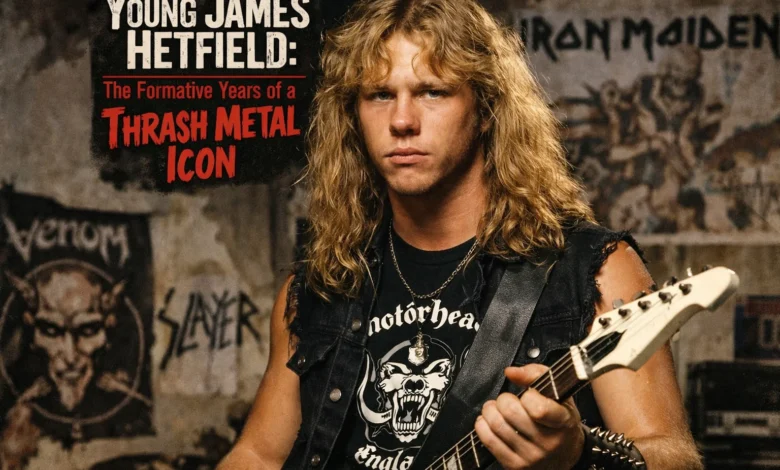
Young James Hetfield: Before the arena screams, before the nine Grammy awards, and before the world knew him as “Papa Het,” there was just a shy, awkward kid from Downey, California, who could barely look people in the eye. Young James Hetfield did not fit the mold of a future rock god. He was quiet, painfully timid, and found solace not in socializing, but in the heavy, driving riffs pouring out of his cheap stereo. If you met him in high school, you would probably have walked right past him without a second glance. And that is precisely what makes his origin story so compelling.


The transformation from that withdrawn teenager into the snarling, down-picking machine fronting the biggest metal band on earth is a journey filled with tragedy, rebellion, and an almost obsessive dedication to the guitar. Young James Hetfield used music not just as a hobby, but as a survival mechanism. It was the voice he did not have. In a household governed by strict religious rules and silence, the guitar became his scream. This article dives deep into those early years—the family struggles, the first crappy bands, the sacrifice of his beloved SG, and the relentless drive that eventually led him to answer a classified ad that would change rock history forever. Buckle up, because the story of the kid who would grow up to write “Master of Puppets” is just as intense as the music itself.
The Unlikely Birth of a Metal God in Downey
To understand the fire, you have to understand the cage. Young James Hetfield was born on August 3, 1963, in Downey, California, a suburb in Los Angeles County that was about as far from the Sunset Strip glam scene as you could get while still being in the same zip code. His family dynamic was, to put it mildly, complicated. His father, Virgil, was a truck driver who struggled with alcoholism, while his mother, Cynthia, was a light opera singer with a gentle soul. On the surface, it might have looked like a standard working-class family, but behind closed doors, a rigid ideology ruled their lives.
The Hetfields were devout Christian Scientists. For young James, this meant no doctors, no medicine, and no health classes in school. When other kids were learning about biology, he was standing in the hallway, feeling like a criminal. This religious isolation cut him off from the normalcy of childhood. He recalls that trying out for the football team required a physical exam, which meant having to explain to the coach that his religion prevented him from seeing a doctor. The embarrassment was crushing. This feeling of being an outcast—of being different in a way that invited ridicule—seeped deep into his psyche. It did not just shape his distrust of authority; it created a well of anger that would later fuel the aggressive, take-no-prisoners lyrics of early Metallica.
The Tragedy That Forged the Fire
The most devastating blow to young James Hetfield came when he was just sixteen years old. His mother, Cynthia, was diagnosed with cancer. However, due to their Christian Science beliefs, she refused all medical treatment, relying solely on prayer for healing. James watched his mother die slowly, powerless and enraged, because faith prohibited the very medicine that could have saved her. She passed away in 1980, leaving a void that would never fully close.
This trauma is the single most important key to understanding the angst of young James Hetfield. Songs like “The God That Failed” and “Dyers Eve” are not just angry rants; they are therapy sessions laid bare for the world to hear. The sense of betrayal—by his parents, by religion, by the universe—became the fuel for his artistic fire. After his mother’s death, his relationship with his father deteriorated rapidly. Virgil, already battling his own demons with alcohol, eventually left, and James went to live with his older half-brother, David. The stability of a traditional family was shattered, and in the rubble, young James found only one reliable companion: his guitar.
Discovering the Guitar: The 1969 SG Story
Young James Hetfield did not have a typical musical awakening. He started with piano lessons at age nine, but as he famously put it, “I wanted to make noise, not study theory”. He messed around on his brother’s drums, but nothing clicked until he was about fourteen. That is when he saw a guitar that would change his life. A local kid from the school jazz band was selling a 1969 Gibson SG standard. For a young metalhead, an SG is a weapon. It is the axe of Tony Iommi, the master of the heavy riff.
James wanted that guitar badly. He worked odd jobs, did every chore he could, and begged his mother to help him scrape together the $200 needed to buy it. When he finally held that SG in his hands, the trajectory of his life shifted. He was not interested in flashy solos or showing off. Young James Hetfield was drawn to the rhythm. He loved the crunch, the drive, the power of a simple, perfectly executed riff. He immersed himself in the instrument, using it as an escape from the chaos of his home life. He later described that feeling of playing as being “in the zone”—a blissful place where there is no pain, no worries, just the music. That SG was not just a guitar; it was his shield against the world.
High School, Hair, and Rebellion
By the time he hit high school, young James Hetfield was starting to find his tribe—or at least, a few other kids who liked loud music. He attended Downey High School before transferring to Brea Olinda High School, where he graduated in 1981. It was in the hallways of these schools that the visual identity of the metalhead began to form. He grew his hair long, a silent rebellion against the conservative norms of his upbringing and the jock culture of the school.
There is a famous story from those years that perfectly encapsulates his attitude. James wanted to play football. He went out for the team, but the coach took one look at his long hair and laid down the law: cut the hair, or you cannot play. For most kids, this would be a simple choice. For James, it was a test of identity. He chose his hair. He walked away from the team. This decision to prioritize his self-expression over conforming to authority figures became a defining trait. While his peers were worried about prom and grades, young James was holed up in garages, thrashing out Black Sabbath covers with his first band, Obsession. He was awkward, he was shy, but on stage with a guitar strapped to his shoulder, he was powerful.
Leather Charm and the Sticker Factory Dreams
After high school, reality hit. Young James Hetfield was not rich, and Metallica did not exist yet. He took a job at a local sticker factory, a mind-numbing gig where he spent hours doing repetitive manual labor. But while his body was stuck on the assembly line, his mind was in the stratosphere. He would spend his shifts daydreaming about riffs, writing lyrics in his head, and planning his escape from the mundane.
During this period, he formed a band called Leather Charm. Unlike his earlier garage jams, Leather Charm was a serious attempt to make it. They played parties, wrote original material, and even recorded a demo. But the band was unstable. Members came and went, and eventually, the project fizzled out. Despite the disappointment, this period was crucial. Young James Hetfield was honing his craft. He was learning what it meant to be a bandleader, even if the band didn’t last. He was also making a massive sacrifice. To fund his musical ambitions, he sold his beloved 1969 Gibson SG to buy a PA system. It was a painful decision, but it showed his commitment. He wasn’t just playing around; he was investing in his future, betting that the voice he found in music was worth more than any instrument.
The Recycler Ad: A Twist of Fate
By late 1981, young James Hetfield was a man with a dream but no outlet. Leather Charm was dead, and he was searching for a way to get his aggressive, original music heard. Enter Lars Ulrich, a Danish-born drummer and son of a tennis pro, who had just moved to Los Angeles. Lars was the opposite of James: loud, brash, and a relentless self-promoter. He had managed to get a track on a British heavy metal compilation called “Metal Massacre,” but he needed American musicians to play it.
Lars placed an advertisement in a local Los Angeles newspaper called The Recycler. The ad read something along the lines of: “Drummer looking for other metal musicians to jam with. Influences: Tygers of Pan Tang, Diamond Head, Iron Maiden.” When young James Hetfield saw that ad, something clicked. He answered it, and the two met up. Their first jam session was reportedly chaotic. James later joked that Lars had a “f*cked up, hella cheap” drum kit. They played some covers, and while it wasn’t love at first sight—James initially blew Lars off—the seed was planted. They realized they shared a rare obsession: speed, aggression, and a desire to push heavy metal to its absolute limit.
The Birth of Metallica and the Demise of the “Young” Era
Once James and Lars started jamming seriously, the fuse was lit. They recruited guitarist Dave Mustaine, a virtuoso from the underground scene, and bassist Ron McGovney. Young James Hetfield was no longer just a shy kid from Downey; he was the frontman of a new beast called Metallica. The name, proposed by Lars, signified the heavy, relentless nature of the sound. The early days were raw. They played tiny clubs like the Troubadour, often to crowds of ten people who threw chairs and shoes at them because they didn’t understand the “thrash” sound.
In 1983, they made the move to San Francisco, fired Dave Mustaine due to his aggressive behavior and drinking problems (replacing him with Kirk Hammett), and recorded Kill ‘Em All. The transition was complete. The awkward teenager who stood in the hallway during health class had transformed into the snarling “Papa Het.” While he would still face decades of personal struggles with addiction and anxiety, the foundation was laid. The rage that came from losing his mother, the isolation of his faith, and the loneliness of his youth were now channeled into the most influential thrash metal band in history.
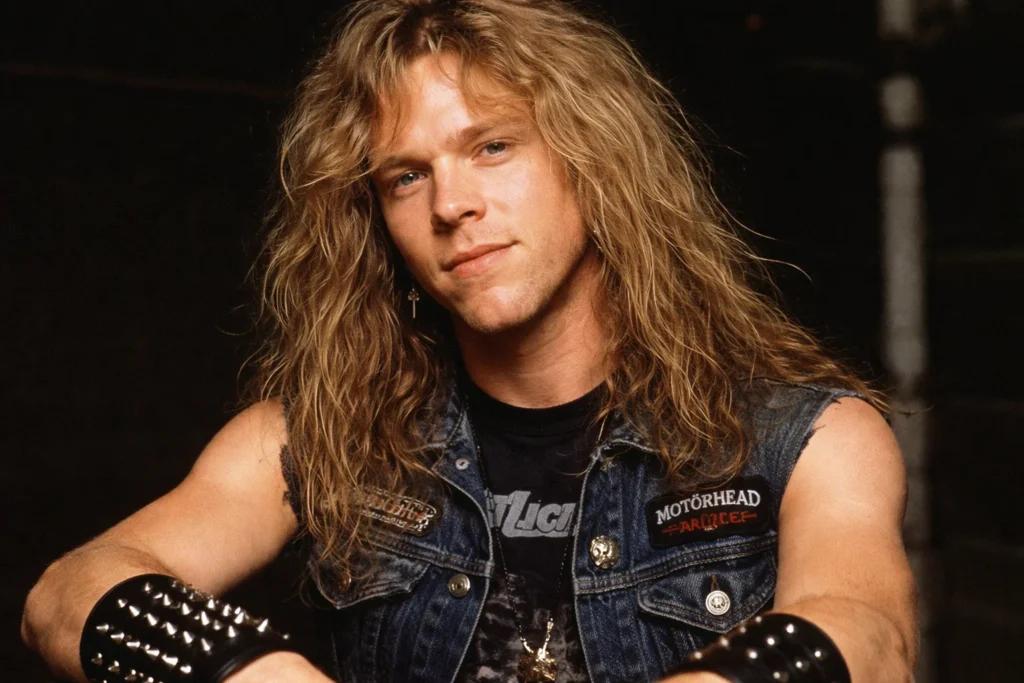
Table: The Evolution of Young James Hetfield (1963–1983)
| Period | Age | Key Life Event | Musical Status | Psychological State |
| Childhood (1963-1976) | 0-13 | Strict Christian Science upbringing; parents divorce | Piano lessons (age 9) | Isolated, confused, “outcast” |
| Teen Tragedy (1979-80) | 16-17 | Mother dies of cancer (refused medical treatment); Father leaves | Acquires first guitar (1969 SG) | Angry, grieving, seeking escape |
| High School Rebel (1980-81) | 17-18 | Quits football team over long hair; Graduates Brea Olinda | Plays in garage band “Obsession” | Defiant, shy offstage, loud onstage |
| The Grind (1981) | 18 | Works at sticker factory; Sells SG for PA system | Forms and dissolves “Leather Charm” | Frustrated, ambitious, daydreaming |
| The Breakthrough (Late 1981) | 18 | Answers Lars Ulrich’s ad in The Recycler | Co-founds Metallica | Energized, aggressive, focused |
The best way to understand young James Hetfield is to hear his own words. He has always been brutally honest about his insecurities and motivations.
“Music was the voice I didn’t have.”
— James reflecting on his shy childhood.
“I was pretty quiet as a child. I kind of hung out with my family and listened to music… I wasn’t too outgoing at all.”
— On his introverted nature.
“Because of your parents’ strong Christian Science faith, did that impact you? … I wasn’t allowed to sit through health class… So I felt really like an outcast.”
— On the embarrassment of his religious upbringing.
“I wanted to make noise, not study theory.”
— On why he switched from piano to guitar.
“I remember the first time we ever got an encore… I had forgotten all the lyrics, but I went through the motions. And after the gig, I just turned right around and punched him [Lars] out onstage!”
— On the chaotic early days of Metallica.
Conclusion
The journey of young James Hetfield is not just a story about learning to play guitar fast. It is a survival story. It is about a kid who had every reason to shut down—facing the death of a parent, religious trauma, and extreme social anxiety—but who chose to fight back using the only weapon he had: heavy metal. From the quiet hallways of Downey High to the chaotic mosh pits of the early LA club scene, he forged his pain into power.
He transformed his “shameful, dark stuff” into riffs that would inspire millions to pick up a guitar. He proved that you do not need to be a smooth-talking frontman or a flashy lead guitarist to be a hero. Sometimes, you just need to be the shy kid in the back with a heavy right hand and something to prove. That kid grew up, answered an ad, and changed the world. And that is why the legacy of young James Hetfield remains one of the most compelling origin stories in rock history.
Frequently Asked Questions
What was young James Hetfield’s first guitar?
Young James Hetfield’s first real guitar was a 1969 Gibson SG standard. He bought it from a local kid in the school jazz band for $200. He later sold that same SG to purchase a PA system for his early musical endeavors, a decision he made to prioritize his band over his instrument.
Why was James Hetfield’s childhood so difficult?
His childhood was marked by the strict Christian Science beliefs of his parents. This religion prohibited medical treatment. Consequently, when his mother developed cancer, she refused to see a doctor and died when James was 16. He also faced social ridicule at school for being pulled out of health classes and not being able to get sports physicals.
How did young James Hetfield meet Lars Ulrich?
James answered a classified advertisement placed by Lars Ulrich in a Los Angeles newspaper called The Recycler in October 1981. Lars was looking for musicians to jam with, and James responded. Despite a shaky first jam session, the two clicked over their shared love for aggressive, fast-paced metal.
What bands did young James Hetfield play in before Metallica?
Before co-founding Metallica, James played in several garage and cover bands during his teenage years. His notable pre-Metallica bands included Obsession, Phantom Lord, and Leather Charm. He played in these groups while he was in high school and immediately after graduating.
Did young James Hetfield take guitar lessons?
James took piano lessons at age nine but found them restrictive. When he picked up the guitar at 14, he was largely self-taught. He learned by listening to records and competing with friends at school. He has stated that his competitive nature in high school, where kids would show off new licks, drove him to learn faster.
What was the first song young James Hetfield wrote?
While it is hard to pinpoint the very first song, James began writing his own original material during his sophomore year of high school. This desire to create original music rather than just play covers was a breaking point for him and led to the dissolution of some of his early cover bands.